Harriet Livermore and the 2520
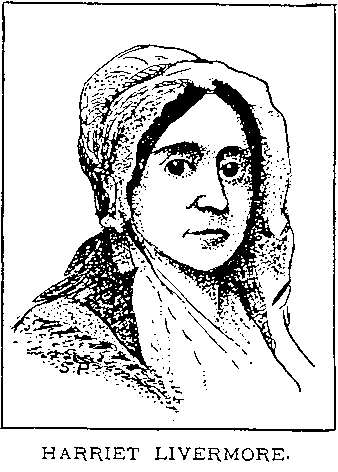
Question: “I was told by my pastor that a woman named Harriet Livermore made up the 2520/seven times prophecy herself and that the Millerites learned about that prophecy from her and not from their own Bible study. Is this claim true?”
Answer: “No! That claim is based in complete ignorance of the facts and totally false on several levels, and I’ll explain why!”
Answer: “No! That claim is based in complete ignorance of the facts and totally false on several levels, and I’ll explain why!”
Harriet Livermore was born in 1788 and as she grew up, she became known as
an eccentric with a volatile temper.
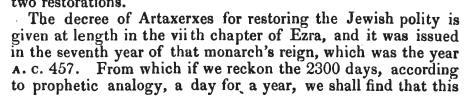
In 1794, when Livermore was only 6 years old, Samuel Osgood (an American statesman and former Postmaster General under President George Washington) wrote multiple references to the 2520/seven times Bible prophecy in his book Remarks on the Book of Daniel, and on the Revelations.
This picture is from page 434 of his book.
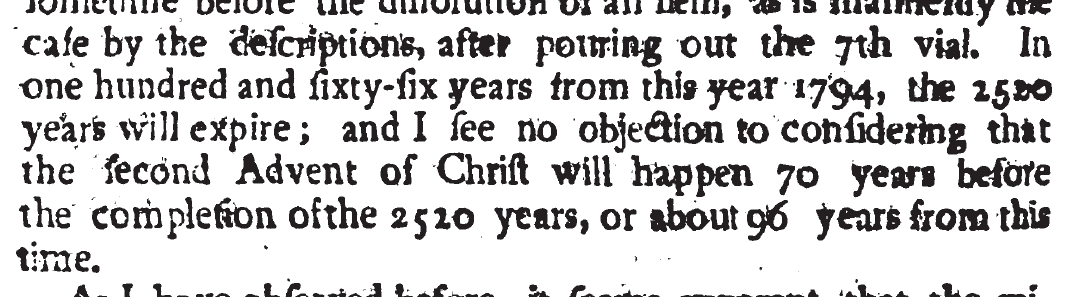
Therefore, there is no possible way that Livermore could have “made up” that prophecy herself because others knew about it long before she did.
In fact, prior to a bad experience in 1811 at the age of 23, she basically had no interest in religion at all! In 1811, Livermore was engaged to a young man, but the man’s parents, not impressed with her eccentric personality, forbade the marriage and annulled the engagement.
Having lost her engagement, she experienced a period of intense internal distress, emotional exhaustion, and personal grief. She decided that her failed romance was a punishment from God for her lack of interest in religion and she set about searching for comfort in religion.
The decade from 1811-1821, she spent in mental theological wrestling and drifting from one denomination to another, looking for her calling.
While Livermore was drifting around and trying to settle into religion, one of those individuals that knew about the 2520 long before she did was studying his Bible.
While Livermore was drifting around and trying to settle into religion, one of those individuals that knew about the 2520 long before she did was studying his Bible.
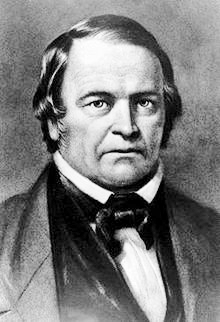
In 1816, William Miller, determined to understand everything he
could about the Bible, began what turned into a
two year study of the word of God.
From the Millerite publication called
The Advent Herald, Vol.X, No.1, August 13, 1845
(in an article titled Mr. Miller’s Apology and Defense)
we find Miller’s own testimony stating what took place
during those two years.
“Soon after this, in the fall of 1816 … I then devoted myself to prayer and to the reading of the word. I determined to lay aside all my prepossessions, to thoroughly compare Scripture with Scripture, and to pursue its study in a regular and methodical manner. I commenced with Genesis, and read verse by verse, proceeding no faster than the meaning of the several passages should be so unfolded as to leave me free from embarrassment respecting any mysticism or contradictions. … In this way I pursued the study of the Bible, in my first perusal of it, for about two years … l found, on pursuing the study of the Bible, various chronological periods extending, according to my understanding of them, to the coming of the Savior. I found that predicted events which had been fulfilled in the past, often occurred within a given time. … When, therefore, I found the 2300 prophetic days which were to mark the length of the vision from the Persian to the end of the fourth kingdom, the seven times continuance of the dispersion of God's people, and the 1335 prophetic days to the standing of Daniel in his lot, all evidently extending to the advent, with other prophetical periods, I could but regard them as ‘the times before appointed,’ which God had revealed ‘unto his servants the prophets.’ … From a farther study of the Scriptures, I concluded that the seven times of Gentile supremacy must commence when the Jews ceased to be an independent nation at the captivity of Manasseh, which the best chronologers assigned to B. C. 677; that the 2300 days commenced with the seventy weeks, which the best chronologers dated from B. C. 457; and that the 1335 days commencing with the taking away of the daily, and the setting up of the abomination that maketh desolate, Dan.xii.11, was to be dated from the setting up of the Papal supremacy, after the taking away of Pagan abominations, and which, according to the best historians I could consult, should be dated from about A. D. 508. Reckoning all these prophetic periods from the several dates assigned by the best chronologers for the events from which they should evidently be reckoned, they all would terminate together, about A. D. 1843. I was thus brought, in 1818, at the close of my two years study of the Scriptures, to the solemn conclusion, that in about twenty-five years from that time all the affairs of our present state would be wound up…”
Notice that from Miller’s own testimony, we see that he “found” the 2520/seven times prophecy directly from his own careful study of the Bible during the years 1816-1818.
In other words, he didn’t learn about it from Livermore or any other human!
Notice also, that he said that he would study each Bible text until it was clear to him and
“free from…contradictions.”
So the claim that the Millerites just accepted the 2520 without study is also completely false!
Notice also what Ellen White had to say about Miller’s 2-year Bible study,
“God sent His angel to move upon the heart of a farmer who had not believed the Bible, to lead him to search the prophecies.
Angels of God repeatedly visited that chosen one, to guide his mind and open to his understanding prophecies which had ever been dark to God's people.
The commencement of the chain of truth was given to him, and he was led on to search for link after link, until he looked with wonder and admiration upon the Word of God. He saw there a perfect chain of truth.
That Word, which he had regarded as uninspired, now opened before his vision in its beauty and glory. He saw that one portion of Scripture explains another, and when one passage was closed to his understanding, he found in another part of the Word that which explained it.
He regarded the sacred Word of God with joy, and with the deepest respect and awe.”
Story of Redemption, p.356
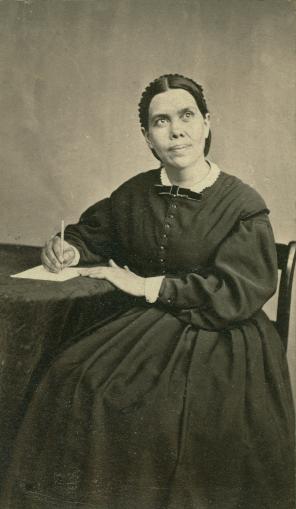
In other words, not only did William Miller come to an understanding of the 2520 from his own careful study of the Bible, but we are specifically told that God’s angels were guiding his mind and opening his understanding to the prophecies of the Bible.
It was not until 1821, at least 3+ years AFTER Miller had already found the 2520 in his own Bible study, that Harriet Livermore finally decided to try to become a preacher.
Her first 10 years of trying to be a preacher (from 1821 to 1831), were spent focused on the regular themes of the gospel, repentance, faithful living, and other religious concepts as well as the abilities of women to preach. During this time period, she also published 4 books. The first (1824) was a theological defense of women preaching and praying in public Christian worship; the second (1826) was compiled from twelve letters to a friend documenting her personal spiritual awakening, emotional struggles, and her early call to preach; the third (1826) was a short evangelical tract/pastoral letter urging young people to seek personal religious conversion and Christian salvation; and the fourth (1831) was a religious novel for children/youth, a fictional narrative to illustrate Christian salvation, piety, and the doctrine of "free grace." None of these publications contained any mention of the 2520 or Bible prophecies in general as Livermore had no real interest, at this point, in Bible chronologies or prophecies.
William Miller, on the other hand, spent the 12+ years (from 1818 to 1831) sharing his beliefs on the Bible and the time prophecies in a more localized setting with family, friends, and acquaintances.
It is also important to realize that while the seed of the Advent Movement was germinating with
William Miller here in America during this same time period, across the ocean and unknown to Miller, British Millenarianism was germinating its own British version of the Advent Movement.
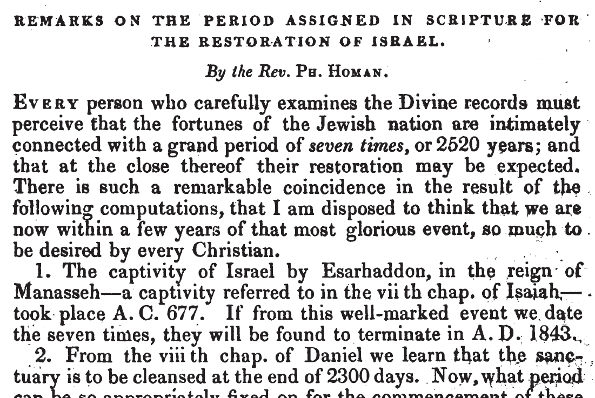
In 1829, Philip Homan, a chaplain in the
Church of Ireland linked to the Anglo-Irish evangelical prophetic movement,
wrote an article for the British evangelical and millenarian periodical called
The Morning Watch.
This article was published on page 271-272 in the first volume of The Morning Watch in 1830.
Here is a picture of the first lines of Homan’s article.
Notice that Homan’s understanding of the 2520 prophecy fits precisely the same as Miller’s understanding.
Yet we know that these two men didn’t know each other and had never communicated with each other, because in Apollos Hale’s
The Second Advent Manual published in 1843,
he states on page 34 that Homan had no knowledge of William Miller (see picture).
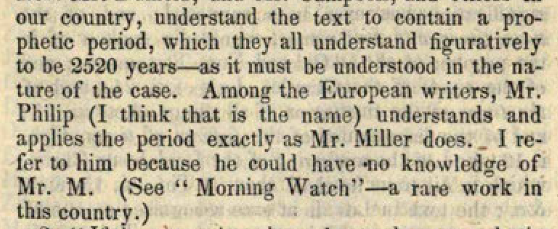
And in E.R. Sandeen’s book, The Roots of Fundamentalism: British and American Millenarianism, 1800-1930, on page 52 it states, “But Miller had not had the opportunity to read and be influenced by the literature of the British millenarian revival. He was left to his own logic and exegesis, and, when his convictions had matured, he remained unshakable.”
In August of 1831, William Miller began his public lecturing on the Second Coming of Christ.
In Sylvester Bliss’ 1853 book titled, Memoirs of William Miller on page 97 we read, “The public labors of Mr. Miller, according to the best evidence to be obtained, date from the autumn of 1831."
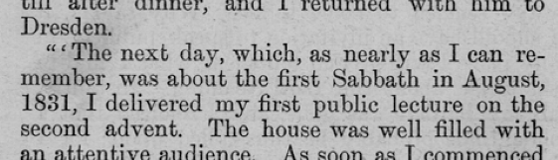
In James White’s 1875 book titled, Sketches of the Christian Life and Public Labors of William Miller on page 80 we read in Miller’s own words,
“The next day, which, as nearly as I can remember, was about the first Sabbath in August, 1831, I delivered my first public lecture on the second advent."
From August of 1831 onward, William Miller’s popularity as a speaker and lecturer escalated and he received so many requests to give public lectures, that he couldn’t even keep up with or fulfill them all.
It was during this same summer (1831) that Livermore read some material written by Joseph Wolff claiming that Jesus was coming in 1847, and it was not until this point that she first began to take an interest in Bible chronology and time prophecies.
She then published her first edition of Millennial Tidings ( autumn of 1831), in which she reprinted some of the material by Joseph Wolff.
There is no reference to the 2520/seven times prophecy in this publication.
Her writings were representative of her eccentric and turbulent nature, being rather confusing, convoluted, and without order. In the book Harriet Livermore, the Pilgrim Stranger, we find
on page 111-112 the following,
“Her method of tracing prophecies is like that of following a river and its branches from their remotest springs and rills in the mountains and hills through ravines and tangled thickets to the ocean; and in the comparing of one prophecy with another, she may have mistaken one for another, and thus her conclusions may not be clear and logical. She confesses her lack of order in writing, as she says: ‘I am aware that my Testimony is not put forth in order, according to the system of man's order; and I cannot write in that manner.’”
“Her method of tracing prophecies is like that of following a river and its branches from their remotest springs and rills in the mountains and hills through ravines and tangled thickets to the ocean; and in the comparing of one prophecy with another, she may have mistaken one for another, and thus her conclusions may not be clear and logical. She confesses her lack of order in writing, as she says: ‘I am aware that my Testimony is not put forth in order, according to the system of man's order; and I cannot write in that manner.’”
It was not until the autumn of 1832,
over a full year AFTER William Miller began
his public preaching, that Livermore published her second edition of Millennial Tidings, in the preface
and appendix of which we find her very first,
brief mention of the 2520 prophecy.
Here is a picture of page 8 in the preface,
and page 101
and page 105
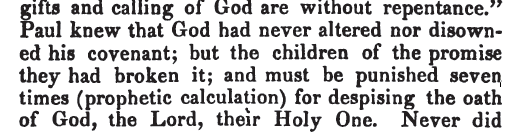
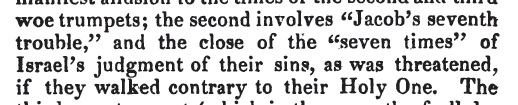
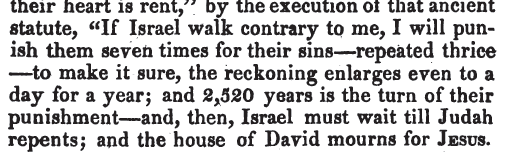
In this 1832 edition of Millennial Tidings, Livermore applied the 2520 prophecy to the scattering of the American Indians who she believed to be the lost tribes of Israel, but as you can see, her mention was casual and she gave no specific details, calculations, or date specifications to this prophecy.
It should also be pointed out, that Livermore believed in the literal restoration of the Jewish nation to Palestine as was the popular but non Biblical belief among many Christians, but differed from the popular view by believing that the American Indians were the scattered Jews that would be gathered back to Palestine.
In contrast, William Miller, and his associates rejected the popular error of the restoration of the Jews. Miller considered that teaching to be false doctrine opposed to Bible truth.
In The Roots of Fundamentalism: British and American Millenarianism, 1800-1930, on page 52 it also states, “The Millerites did not accept the restoration of the Jews to Palestine as a part of the prophetic timetable, nor were they willing to admit that biblical prophecy had any further promises to keep so far as the Jews were concerned.”
Miller specifically stated, “...the Jews have had their day…”
History of the Second Advent Message and Mission, Doctrine and People p.165
Note that Livermore’s very first mention of the 2520 is some 38 years AFTER Samuel Osgood’s reference to it, over 14 years AFTER Miller states that he found it in his own Bible study, 3 years AFTER chaplain Philip Homan wrote about it, and a whole year AFTER Miller began his public lectures on prophecy!
By this time in 1832, many people all around the New England area, had already heard Miller’s lectures, so the idea that Harriet Livermore made up the 2520 prophecy and introduced it to the Millerites
is ludicrous.
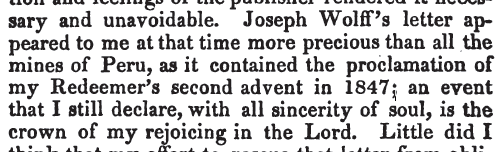
Besides those facts, in 1832, Livermore was still attempting to promote Wolff’s ending date of 2300 in 1847 as can be seen in Millennial Tidings #2.
Because she believed the prophecies pointed to 1847, her use of the 2520 would imply that ending date, but she didn’t mention any dates in connection with the 2520.
On the other hand, Miller’s applications of the time prophecies (including the 2520) were focused on the ending date of 1843.
So here again, there is no possible way for Livermore (whose teachings and beliefs differed from those of the Millerites) to be the source of the Millerite understandings on the 2520!
It was not until 1839, 45 years AFTER Samuel Osgood wrote about the 2520,
21+ years AFTER Miller had found the 2520 for himself,
10 years AFTER Philip Homan wrote about it,
and 8+ years AFTER Miller had begun publicly lecturing on the prophecies,
that Livermore published her fourth edition of Millennial Tidings.
This 1839 edition is the very first detailed reference of Livermore to the 2520 and, true to her confusing and convoluted reasoning, she describes the 2520 as ending in 1843 on some pages and on others she promotes Wolff’s 1847 date. Here are pictures of page 13 and 15,
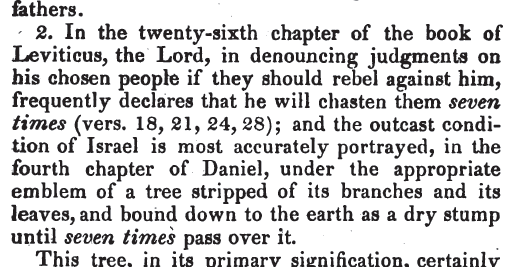
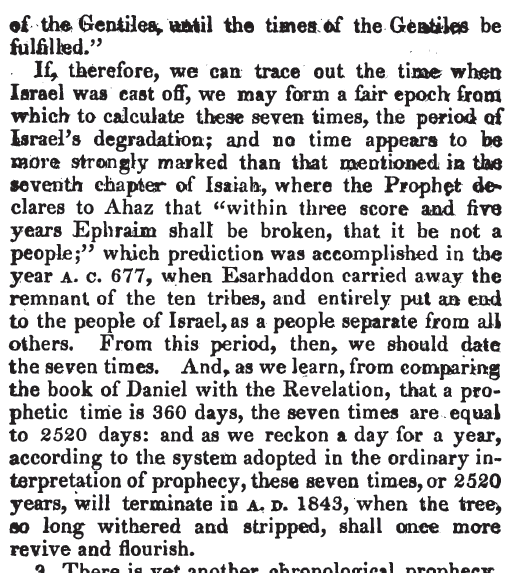
But this part about the 2520 ending in 1843 isn’t even Livermore’s words! Livermore is simply republishing someone else’s material!
We get a clue of her source from the title page,
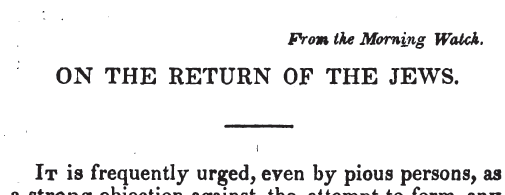
So we see that she is simply republishing something from that British paper, The Morning Watch.
With a little research, we find that her supposed reference to the 2520 is word for word quoting from p.353-356 of The Morning Watch; or, Quarterly Journal on Prophecy, and Theological Review, vol.6, 1833.
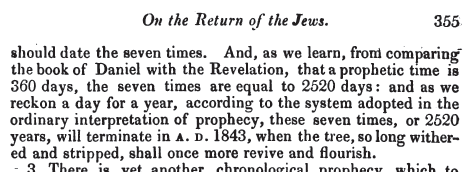
So Livermore’s extent of knowledge of the 2520 in 1839, she got from the publications of the British Advent Movement in England that had been printed back in 1833!
By 1840, the lectures of Miller had ignited the fire of the hope of the Second Coming in the hearts of thousands, and his lectures, promoting his understandings of the time prophecies (including the 2520) were circulating everywhere.
But we know that Livermore had had no connections with the Millerites, because she had been overseas in Jerusalem, and arriving back in America, in the summer of 1842, she experienced
her first introduction to the Millerites.
In the book Harriet Livermore, the Pilgrim Stranger (p.111) we find that in 1843, Livermore actually wrote about the Millerites,
“On my return to this country last summer [1842] I heard that a new sect had appeared whose teachers denied the restoration of the twelve tribes of the children of Israel to their covenant land, and to the special favor of God; that those teachers proclaimed the coming of the Saviour to burn up the world in 1843.”
“On my return to this country last summer [1842] I heard that a new sect had appeared whose teachers denied the restoration of the twelve tribes of the children of Israel to their covenant land, and to the special favor of God; that those teachers proclaimed the coming of the Saviour to burn up the world in 1843.”
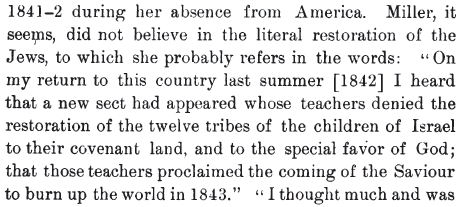
Notice, that according to Livermore’s own words, she had not heard of the Millerites prior to the summer of 1842 when she returned to America.
In other words, here again, we see that there is no possible way that she could have taught the Millerites about the 2520, because by the time she actually learned about the Millerites, the Millerite movement (along with their understanding of the 2520) had exploded across the northeastern and midwest United States, up into Canada, and was even making its way over to Great Britain!
So “No!” The Millerites did not get the 2520 from Harriet Livermore!
They got it from William Miller and the Bible!
And actually, when you stop and think about it, if we were supposed to reject the 2520 because Harriet Livermore talked about it, then by default, we’d also have to throw out the other prophecies that she talked about as well, such as the 2300 which she also mentions on the same page.
And actually, when you stop and think about it, if we were supposed to reject the 2520 because Harriet Livermore talked about it, then by default, we’d also have to throw out the other prophecies that she talked about as well, such as the 2300 which she also mentions on the same page.
It is much safer to believe what the Bible and Spirit of Prophecy teach, than to base any beliefs on the arguments of ignorant critical scholars!